

1What Is a Traditional Cameroonian Wedding?
A traditional Cameroonian wedding, also called a customary marriage, unites two people according to their families' customs. It takes place within the family, before parents, elders and often the whole neighbourhood. Above all, it seals an alliance between two families, not just between two spouses. In Cameroon, each people has its own rites, and each family adapts them in its own way.
In practice, there are three forms of marriage: customary, civil and religious. A civil marriage takes place before the civil registrar. A religious marriage happens in a church, a temple or a mosque. You can have all three, in the order that suits your families. However, their legal effects differ, as we explain further down.
This guide is for couples preparing their union, for the diaspora, and for Europeans who are guests or future spouses. It describes common landmarks and a few documented customs. For your own traditional Cameroonian wedding, however, the family itself remains the best source.
2The Main Steps, From One Family to Another
First comes an introduction visit, which many people call 'knocking on the door'. The groom-to-be visits his fiancée's family with a few relatives. He states his intentions and brings gifts. Then the bride's family explains what it expects next: visits to uncles, aunts and grandparents, and a list of gifts.
Next comes the formal request, which spokespeople often lead. Each family chooses a speaker who talks on its behalf. The exchange sometimes turns into a verbal contest, full of proverbs and humour. Finally, both families gather for the dowry ceremony. For its meaning and how to discuss it at home, read our guide to the dowry in Cameroon.
The customary ceremony often ends with a blessing from the elders, followed by the party: food, music and dancing. A traditional Cameroonian wedding can fit into one evening or stretch over several months. Names, order and gestures change between peoples, villages and families. So always ask for the programme your family has planned.
3In the West: Examples From Bamiléké Country
A study from the University of Yaoundé 1 describes customary marriage among the Ghomala, in Bandjoun and Bamengoum. After the 'knocking on the door', the dowry ceremony itself takes place in the bride's family compound. It generally starts in the evening and ends at dawn. First, the two families' spokespeople face off in a game of questions and answers.
Then comes a playful, humorous moment. The groom's family must recognise the bride among several young women who appear with their faces hidden. Finally, the union rite seals the alliance: the officiants mix two drinks, palm wine and juice, and the couple drink the blend. Before she leaves, her father or the head of the family blesses her.
In Bafou, another Bamiléké community, a researcher from the École normale supérieure in Yaoundé studied the songs of customary marriage. Women sing them in the Yemba language during the night-long celebration. They call out members of the groom's family, who stand up to dance. The songs also pass on advice to the couple. However, these examples remain local: a traditional Cameroonian wedding in a neighbouring village may follow other codes.
4Centre, Littoral, North: Other Customs
In the Centre region, a master's thesis from Université Laval describes Yambassa customary marriage in Mbam-et-Inoubou. During the request, two speakers hold a real verbal contest, fly whisk in hand. The family's speaker asks the young woman whether she loves her suitor. Then the young man offers her palm wine and a kola nut. If she agrees, she passes them to her elder.
The elder then pours a few drops on the ground for the ancestors, says a blessing and drinks. Next, the young woman serves her fiancé. Later, when her family formally hands her over, they accompany her to her husband's home. This account highlights an essential point: the young woman expresses her consent in front of everyone.
On the coast, the Sawa peoples have their own dress codes, such as the kaba and the sanja. Among the Beti, the Bassa or in the North, steps, symbols and the role of religion differ again. So instead of generalising, ask the elders in each family. Also, a traditional Cameroonian wedding between two different origins may honour two customs, one after the other.
5Attire and Symbols at a Traditional Cameroonian Wedding
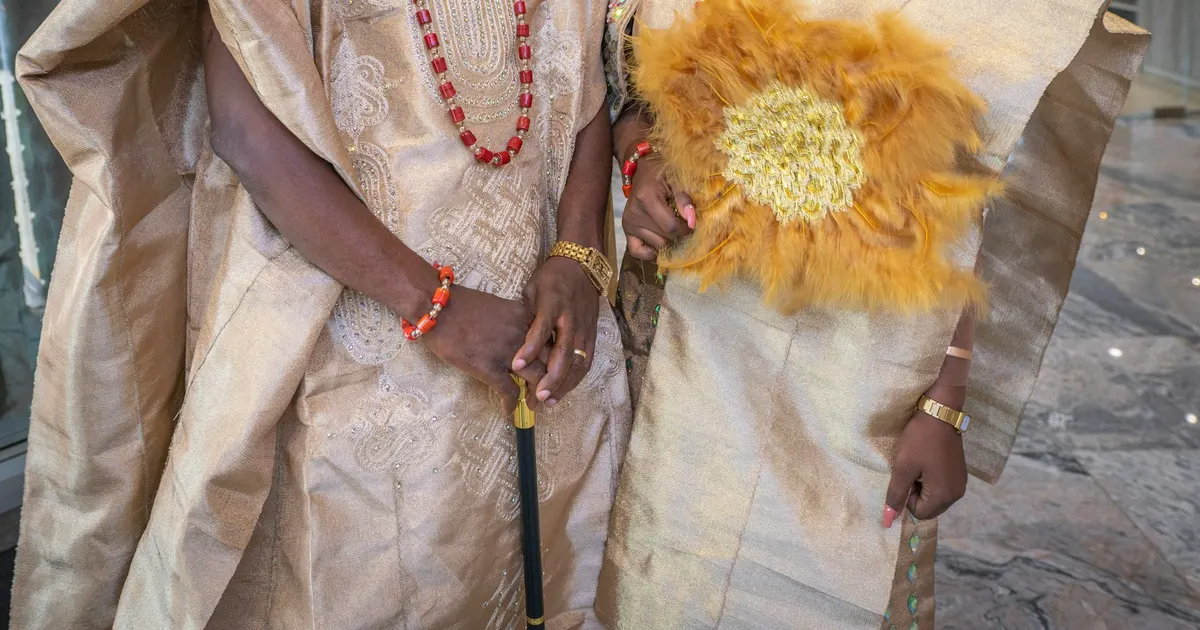
Clothing says a lot about where families come from. The toghu, or atoghu, comes from the North West, in the Grassfields. It is a heavy black velvet with embroidered patterns, typically red and white. Once reserved for royalty, it now appears at weddings and traditional festivals alike. On the coast, the kaba (a long, loose dress) and the sanja (a wide skirt) belong to the Sawa peoples. People wear them at happy occasions and at ceremonies such as the Ngondo.
Printed cloth, known as pagne, also plays a big role. In Cameroon, engagements and weddings often mark the 'release' of a new fabric design. People keep a sample as a souvenir. If the family has chosen a fabric, ask how to get it and which style to have made. Wearing it is a lovely way to join in the celebration.
Some elements appear in several rites that researchers describe: palm wine, kola nut and the elders' blessing. However, their exact meaning depends on the group. At a traditional Cameroonian wedding, avoid reading meaning into a gesture without asking. A curious question always goes down better than an assumption.
6Planning the Ceremony Without Overspending
A beautiful traditional Cameroonian wedding does not depend on the number of drink crates or the size of the hall. First, set a budget together, then share it with the people in charge in each family. Say clearly what you can afford. In practice, a list negotiated with respect beats a debt that weighs on your first years together.
Elders and spokespeople hold a central place. Choose speakers who know the customs and can calm tensions. For guests from the diaspora, announce the date early, because international travel takes time to plan. For absent relatives, also plan a video call during the party.
The venue depends on custom: the family compound in the village, the parents' house in town, or a rented hall. Finally, agree on the order of ceremonies with both families: customary, civil, religious, or another sequence. A written programme, shared in advance, prevents many misunderstandings on the day.
- Name one contact person in each family.
- Write down the budget and the list, then keep a copy.
- Ask a relative to translate for guests who do not speak the local language.
- Send distant guests the programme and dress code for the traditional Cameroonian wedding early.
7Legal Value: Civil Status in Cameroon and Belgium
In Cameroon, Law No. 2024/016 of 23 December 2024 organises civil registration. Under this law, the civil registrar of the place of birth or residence of one future spouse celebrates the marriage. For a customary marriage, the spouses must declare it to the civil registrar. After public notice, the registrar records it in the register.
For civil status, what counts is therefore the entry in the register. That covers a marriage the registrar celebrates, or a customary marriage declared and then transcribed. Also, a Cameroonian living abroad who marries before local authorities there must declare it. The embassy or consulate then transcribes it. A traditional Cameroonian wedding keeps its full family value, but its legal effects go through civil registration.
In Belgium, the Federal Public Service Foreign Affairs explains that Belgium can recognise a foreign marriage certificate under conditions. It must meet the basic conditions of each spouse's national law and the formalities of the country of celebration. Have it legalised or apostilled, and translated if necessary. Then the registrar of your municipality can register it. To bring your spouse over, read our guide to family reunification in Belgium. Finally, these rules change, so always check with your civil registry centre, your municipality or the embassy.
8European Spouse or Guest: Good Habits
Are you marrying a Cameroonian partner, or has a family invited you to its traditional Cameroonian wedding? Start by asking your partner and their family your questions: programme, expected role, dress code, gifts. In an intercultural relationship, these conversations matter as much as the party. Above all, do not go alone: a family member or close friend can guide you through the ceremony.
For clothing, follow the requested code: the family's fabric, a toghu, a kaba or smart party wear. Greet the elders first, calmly and politely, and let them speak before you. If you cannot accept a dish or a drink, decline with a smile and a word of apology. Finally, ask before filming a rite: some moments call for no phones.
Did your story begin with dating in Yaoundé, or online from Europe? Then prepare the ceremony together well in advance. On Koeur24, a dating site founded in Belgium, private messaging and video calls help you keep talking despite the distance. For a traditional Cameroonian wedding, though, nothing replaces time spent with both families.
- 'Could you explain this part of the ceremony to me?'
- 'Where should I sit, and when can I greet your parents?'
- 'May I take a photo, or should I wait?'
- 'Thank you for welcoming me into your family.'